Showing posts with label endangered. Show all posts

Wednesday, 23 December 2015

Save Tapirs and Apes to Combat Climate Change!

Nias as a young baby. His species, the Malayan tapir, actually have a role
to play in climate change! (Taken at Port Lympne, December 2014)


No Monkey Business

What link may a tapir, a gibbon and a polar bear have? The answer is "climate change", as crazy as it sounds. This article by The Guardian (Carrington, 2015) discusses a recent study by the University of East Anglia that shows that the disappearances of large animals, such as tapirs and primates, could have enormous impacts on climate change (and that's where the polar bear, which is famously vulnerable to climate change, comes in). 
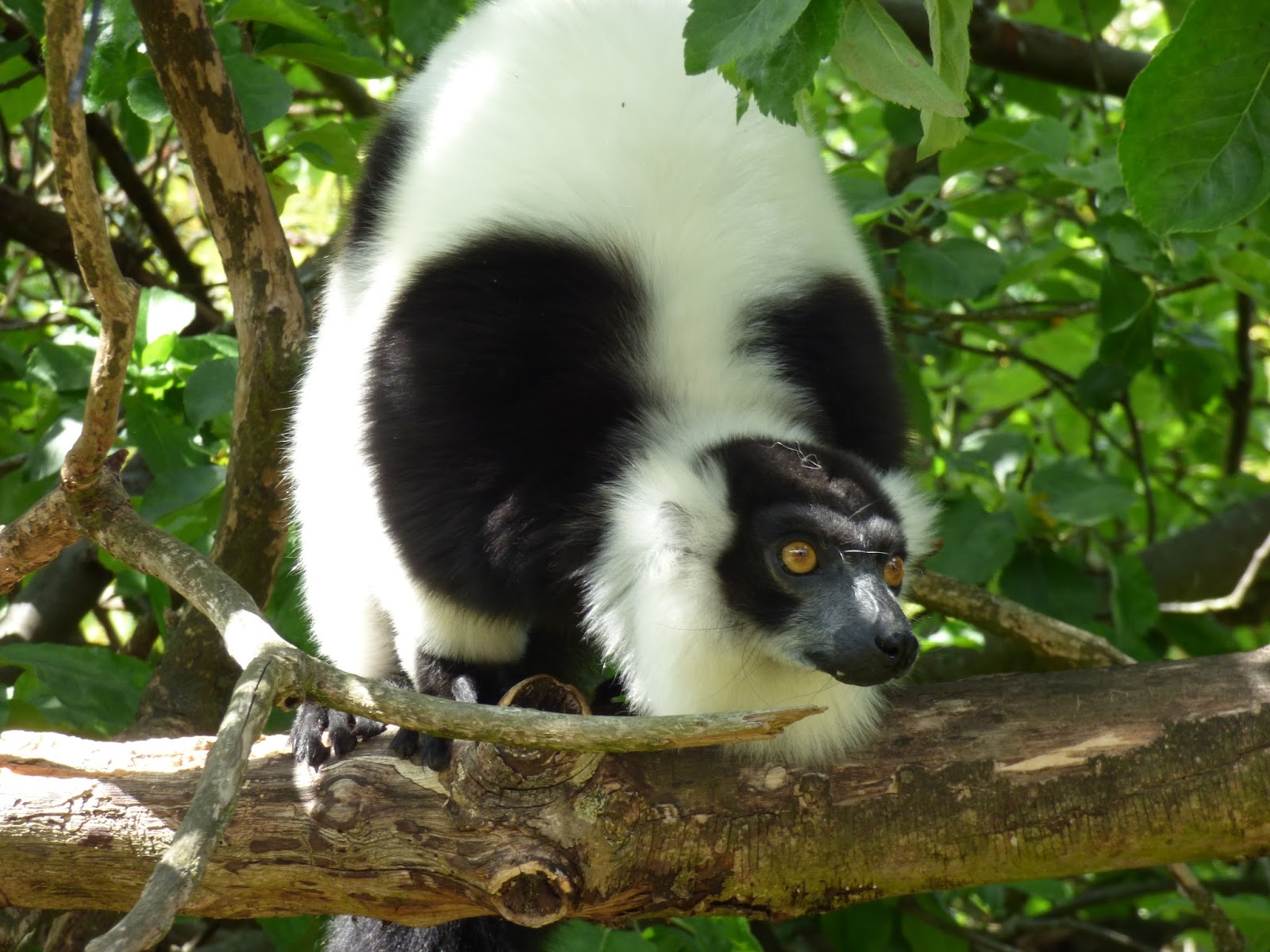
Aramis, a black-and-white ruffed lemur at Howletts (July
2015). The extinction of primates would have devastating
consequences on fighting climate change.
Tapirs are large, forest dwelling, fruit eating ungulates. Most species live in South and Central America, and the highly endangered Malayan tapir is found in South-East Asia. Additionally, the majority of the world's forest-dwelling primates (not just monkeys, but the great apes, gibbons, lemurs, etc.) and some large birds (such as toucans) eat fruit. This simple fact is why they're absolutely essential. The undigested seeds will be passed on through their faeces onto the forest floor, allowing new hardwood trees to be sowed- seed dispersal as its most natural!


So, What's It To Do With Climate Change?

The study, conducted in Brazil, found that where the tapirs and monkeys had disappeared, so had the hardwood trees. Instead, smaller species, such as bats, were dispersing the seeds of smaller softwood trees; these then replaced the hardwood, disturbing the natural mix between the two types of tree. The larger hardwood trees have more capacity to store carbon. Such a dramatic change in the ecosystem led to a 10-15% decrease of carbon storage!  

All species of tapir are considered to be threatened with extinction (IUCN, 2015), and another recent study showed that over half of primates face the same fate (Echaves, 2015). Therefore, we face yet another massive problem in combating carbon emissions.

We all know that the fight against climate change is complex. To combat it, we must reduce deforestation and deviate away from our dependence on fossil fuels, among other things. It seems that now, we must also turn our attentions to protect those wonderful rainforest species from extinction!

Emba, a Western lowland gorilla at Howletts (July 2015). Keeping
great apes from extinction is vital to combat carbon emissions! 

References

Carrington (2015) Loss of monkeys and birds in tropical forests driving carbon emissions Available at: http://www.theguardian.com/environment/2015/dec/18/carbon-emissions-loss-of-monkeys-and-birds-in-tropical-forests Date accessed: 23rd December 2015

Echaves (2015) Over 50 Percent Of The World's Primate Face Extinction Available at: http://www.sciencetimes.com/articles/7792/20151126/over-50-world-s-primate-face-extinction.htm Date accessed: 23rd December 2015

IUCN Red List of Threatened Species (2015) Tapirus bairdii Available at: http://www.iucnredlist.org/details/21471/0 Date accessed: 23rd December 2015; Tapirus indicus Available at: http://www.iucnredlist.org/details/21472/0 Date accessed: 23rd December 2015; Tapirus pinchaque Available at: http://www.iucnredlist.org/details/21473/0 Date accessed: 23rd December 2015; Tapirus terrestris  Available at: http://www.iucnredlist.org/details/21474/0 Date accessed: 23rd December 2015

Monday, 30 November 2015

Will The Lion Sleep Tonight?

Already extinct in the wild... Layla (front) and Jabir, the pair
of Atlas lions at Howletts (August 2015)


The Last Roar

Milo the Atlas lion at Port Lympne Reserve-
a very special cat indeed (July 2014)
If there was one sound during my time at The Aspinall Foundation that I found I was lucky to hear, it was the mighty roars of the lions that echoed around the parks. These lions are not the "ordinary" African lions, They're Barbary, or Atlas, lions, formerly found in North Africa. They are much larger than African lions, and have impressive dark manes.

They are already extinct in the wild, and there are very few in zoos around the world. 

Now immediate efforts must be taken to ensure that the remaining lions do not end up the same way.

The King Needs Help!


Asiatic lions, found only in India, are considered to be Endangered (IUCN, 2015). However, thankfully, their numbers are reasonably stable.

African lions, in sub-Saharan Africa, are Vulnerable and declining in numbers- at a very rapid pace. (IUCN, 2015) 

Spike, an African lion at Whipsnade Zoo (October 2013)
Most notably, lions have decreased by 89% since 1993 in Nigeria, leaving just 32 individuals in this country. Kenya and Tanzania have also suffered losses of 40% and 66% respectively (Fair, 2015). As the human population continues to expand, human-lion conflicts become more evident. Habitat loss through burning, tree felling and urbanization is a real problem. The loss of prey is also a major factor; this is partly down to habitat loss, but mainly down to poaching and the bushmeat trade (IUCN, 2015). As their natural prey declines, lions may turn to livestock, resulting in shootings and poisonings, either in self defense or for the protection of livestock.

(Nearly) Sleeping lions, Layla (front) and
Jabir (July 2014)
However, there are just a few southern African countries (namely, South Africa, Zimbabwe,  and Namibia) that have seen a rise in the number of lions, and they've all done it differently. Fair's article (2015) discusses how South Africa has fenced their lions from the human population. This has apparently led to a decrease in the lion-human conflict; fencing the reserves therefore appears to have served both the locals and the lions well. If we are to protect an apex predator, then the concerns of local people must also be addressed. Additionally, it appears to be economically viable. The article points out that fenced reserves could cost $500 per square kilometre (whereas unfenced would cost four times as much). Furthermore, the fenced reserves could protect 80% of the potential lion population density (compared to just 50% in unfenced populations).

Nonetheless, this is not a black-and-white issue. Namibia does not fence lions due to its low human population, meaning there is comparatively little human-lion conflict. Zimbabwe's lion population has soared since the 1990's. This is not due to a highly controversial trophy hunting economical model in the Bubye Valley Conservancy (I am absolutely not condoning trophy hunting at all for the record).

As it always is with apex predator conservation, it is far from simple. Do we really want to see lions fenced and semi-wild? Do we want to save them through controversial trophy hunting?

It raises some very difficult questions, but we absolutely cannot let them end up like the Atlas lions.


Bless you, Layla! (August 2014)


References

Fair, J. (2015) Is It Time To Stand Up For All Of Africa's Lions? BBC Wildlife, October, pp.52-54

IUCN Red List of Threatened Species (2015) Panthera leo ssp. persica Available at: http://www.iucnredlist.org/details/15952/0 Date accessed: 28th November 2015; Panthera leo Available at: http://www.iucnredlist.org/details/15951/0 Date accessed: 28th November 2015


Wednesday, 18 November 2015

The Deep Blue Disaster

Shark Trust, 2015

No Limits? No Future!

The other day, I posted about the ICAAT (International Commission for the Conservation of Atlantic Tunas) meeting in Malta. As the conference drew to a close, the Shark Trust press release was published. It could not have left a more bitter taste in the mouth if possible, and reading through, it is difficult to not get frustrated: it is a complete disaster. 

The Shark Trust's No Limits? No Future! campaign had a number of very vulnerable sharks, most of which can be found in British waters, at its heart. Particularly featured were:

- The blue shark, for which there are no limits to the number that can be taken in Atlantic waters. Annually, in excess of 10 million are taken for their fins alone (Shark Trust, 2015) 

- The shortfin mako shark. Again, there are no limits to the quantity that can be taken in Atlantic waters. 

- The porbeagle. There was a campaign to ban the retention of the species. 

- The common thresher shark. Proposals to ban capture were made. 

The common thresher and shortfin mako are Vulnerable and the blue shark Near Threatened with extinction. The porbeagle is globally Vulnerable, and Critically Endangered in the Northeast Atlantic (IUCN, 2015). 


What Happened? 

A fifth proposal to clamp down on the finning of sharks at sea- a highly destructive, wasteful method of shark fishing- was also made. Despite the increase in the number of countries (now containing 30 of the 50 countries involved in the ICAAT) showing support for a stronger "fins-free", the move was blocked by Japan, South Korea and China.


Shark Trust, 2015
The article also points out that Japan tried to propose a 32% increase in blue shark takings in the South Atlantic; despite a back-up by the European Union, the call was rejected by the USA and Norway, and so there was no action taken on the species. The EU proposals to clamp down on shortfin mako and common thresher catches were also fought (led by Japan). The only objective where small progress was made was with a small compromise between the EU and Canada (which previously blocked the proposal for the taking of the species) for the porbeagle shark. The compromise was to encourage live release.

If we fail to protect the sharks, and we fail to protect our oceans, then how are we to protect anything? Has anything at all been learned from other man-made extinctions? 

And how would we be able to explain to future generations that we failed to get a grip on the steadily dwindling numbers of top predators?

References

IUCN Red List of Threatened Species (2015) Prionace Glauca Available at: http://www.iucnredlist.org/details/39381/0 Date accessed: 18th November 2015; Isurus oxyrinchus Available at: http://www.iucnredlist.org/details/39341/0 Date accessed: 18th November 2015; Lamna Nasus Available at: http://www.iucnredlist.org/details/11200/0 Date accessed: 18th November 2015;  Lamna Nasus (Northeast Atlantic Population)  Available at: http://www.iucnredlist.org/details/39343/0 Date accessed: 18th November 2015; Alopias vulpinus Available at: http://www.iucnredlist.org/details/39339/0 Date accessed: 18th November 2015

Shark Trust (2015) Blue Shark Available at: http://www.sharktrust.org/en/blue_shark Date accessed: 18th November 2015

Shark Trust: No Limits? No Future! (2015) PRESS RELEASE: Japan Blocks 4 out of 5 Shark Conservation Proposals at Atlantic Tuna Meeting Available at: http://www.nolimitsnofuture.org/press-release-iccat2015/ Date accessed: 18th November 2015

Monday, 16 November 2015

Cinderella Species Matter Too!

The Critically Endangered Philippine Crocodile at Paignton Zoo (May 2015).
There are only 250 left in the wild, but they're not likely to be a poster
child for conservation!

Mirembe, the youngest member of the African elephant
herd at Howletts Wild Animal Park (14 months in this
photo, August 2015). Her herd, the largest in the UK,
is one of the most popular draws to the park, along with the
world famous gorilla collection.

What Is A Cinderella Species?

What comes to your mind when you hear the term "endangered species"? 

Do you think of the scimitar horned oryx, painted dog, humphead wrasse, Cuban crocodile, porbeagle, eastern bongo, Golden mantella frog, American burying beetle, or even a plant?

Or is the first thing that springs to your mind something along the lines of a tiger? African elephant? Gorilla? Whale? Panda? Orang-utan? Sea turtle? Snow leopard? 

A lot of attention and money is spent on the latter species, the charismatic fauna that normally are the first few animals that pop up on a quick "endangered species" Google Images search. They are the species that we see when we turn the television on and see a WWF adoption advert, and they are the species who we, as a society, are most likely to dig deep into our pockets for. The WWF, one of the world's largest conservation bodies, had an income of £46.43 million in 2009, 46% of which came from individual donations and memberships (n.d.). The organisation uses the aforementioned charismatic megafauna to bring in donations, and uses the giant panda as its logo.

However, what about the Cinderella species? These are the species not seen as being as charismatic. These are the "forgotten species" that are just as endangered (or if not, more so) as the charismatic megafauna such as pandas and tigers. Yet they do not get nearly so much publicity or attention, and therefore do not get so much money spent on their conservation.  

However, it by no means mean they're less important. In fact, it's the complete opposite. They deserve much better. 

Why Do They Matter?


Now let's also look at a specific Cinderella species, a special antelope species at Howletts Wild Animal Park (where I volunteered for the education department over the summer).
One of two Eastern Bongo calves at Howletts Wild Animal
Park (July 2015)

The Eastern, or mountain, bongo is a Critically Endangered antelope species. This is unlike the western, or lowland, bongo, which is not currently threatened (IUCN, 2015). Found only in Kenya, there are only around 150 of them left in the wild. They've been relentlessly poached, and have also fallen victim to habitat destruction. Sadly,  when informing the public of their plight in the wild, very many were surprised and unaware that it was more endangered than our pair of Sumatran tigers! Yet, like so many others, the species does not generally get the publicity is very much deserves. When was the last time you turned the television on and saw an advert asking you to adopt an Eastern bongo?

Why would it matter if this creature goes extinct?  

Think of the ecosystem as one giant, complicated jigsaw puzzle. It needs every single piece to be present, in the correct order, so that it can work and be complete. Let's use a West African rainforest as an example. First, you would need the soil and all its inhabitants to be present. Without this, forget everything else. Then, you would need the plants to fill in parts of the jigsaw- not just the enormous trees, or the beautiful flowering ones, but the ferns, the shrubs, the bushes, etc. Then you'd need the insects, and so on, and so forth. Eventually, the jigsaw would be complete, and you'd be able to see a healthy, functioning ecosystem which also contains the charismatic megafauna such as forest elephants, gorillas and leopards.

In the ecosystem, nothing is more important than another. They're equal. All organisms- no matter how small or large , how scary or hairy, how beautiful or ugly- matter just as much! 


Indah, the gorgeous Sumatran tiger at Howletts Wild Animal Park
(June 2015). Her species would not be able to survive without
the Cinderella Species that hold her ecosystem together! 

References

IUCN Red List of Threatened Species (2015)  Tragelaphus eurycerus ssp. eurycerus Available at: http://www.iucnredlist.org/details/22058/0 Date accessed: 16th November 2015; Tragelaphus eurycerus ssp. isaaci Available at: http://www.iucnredlist.org/details/22057/0 Date accessed: 16th November 2015
WWF (no date supplied) Income and expenditure Available at: http://www.wwf.org.uk/about_wwf/other_publications/annual_review_archive/annual_review_2009/raising_support/income_and_expenditure/ Date accessed: 16th November 2015

Sunday, 15 November 2015

Justice For Jaws

A shortfin mako (back) and blue shark (front), two species at the centre
of the ICCAT conference (Andy Murch)

No Limits? No Future!

Tope. Blue shark. Porbeagles. Shortfin mako. Smoothhounds. Catsharks. These beautiful species of shark can all be found in British waters.  Yet, as is a sadly common story in this day and age, they're all in pretty sharp decline. These sharks are commonly landed in Atlantic waters, accounting for around 97% of sharks landed by fisheries in the region. Statistics collected in 2012 show that 280,000 tons of these sharks were landed in Atlantic waters, although the true statistic is likely to be as much as quardruple this. (SharkTrust, n.d.).  It's about high time that something was done to help sharks before it is too late!

The Shark Trust is currently heading a campaign called No Limits? No Future!, and is also currently attending the International Commission for the Conservation of Atlantic Tunas (ICCAT) meeting in Malta. 

The IUCN lists the shortfin mako as being Vulnerable to extinction and decreasing in numbers and the blue shark to be Near Threatened (2015). The campaign seeks to finally place limits on the numbers of these sharks landed in Atlantic waters annually, as well as prohibiting the retention of the Porbeagle Shark (Shark Trust, 2015), which the IUCN lists as Vulnerable and decreasing in numbers. 

Porbeagle shark (Canadian Shark Research Lab) 

The Marine Conservation Society says that Porbeagle meat is among the most valued of all shark meat (2015). It is also used in vitamin supplements! Though it is protected by the EU and in Uruguay (Shark Trust, 2015), it is not protected anywhere else in the Atlantic.
Nursehound (or bull huss) in the National Marine Aquarium (February 2015)-
an often overlooked, yet commonly consumed, species
of shark


In a world where half of the world's marine life has perished in the last 40 years we absolutely must start taking care of our oceans. It is not just about protecting the species we love most. It is about caring about the entire ecosystem for the planet's sake, and for own!

References

IUCN Red List of Threatened Species (2015) Isurus oxyrinchus Available at: http://www.iucnredlist.org/details/39341/0 Date accessed: 15th November 2015; Prionace gluaca Available at: http://www.iucnredlist.org/details/39381/0 Date accessed: 15th November 2015; Lamna Nasus Available at: http://www.iucnredlist.org/details/11200/0 Date accessed: 15th November 2015

Marine Conservation Society (2015) Porbeagle Shark Available at: http://www.mcsuk.org/support_mcs/Get+involved/30+species/30+Species+-+Porbeagle+shark Date accessed: 15th November 2015

Shark Trust (2015) ICCAT Available at: http://www.sharktrust.org/en/iccat Date accessed: 15th November 2015


Shark Trust- No Limits? No Future! (no date supplied) The Campaign Available at: http://www.nolimitsnofuture.org/campaign/ Date accessed: 15th November 2015

Friday, 7 August 2015

A Croak About Amphibians and Reptiles

Let's Croak About Frogs

I say "croak". Firstly, obviously, frogs croak so in some ways this is one of those awful, childishly cheesy puns that you see on the front of The Sun or something. Secondly, I AM croaky. I've just finished a day of volunteering at Howletts and spoke to so many people (I'm in the education department) that I am now croaking nearly as much as the animals I'm about to talk about. It was great, though. Although there were certainly no frogs involved (Howletts doesn't look after frogs) and it's Javan primate week (there were a lot of masks of gibbons and lutungs/langurs/leaf monkeys/whatever-you-want-to call-them being made in a variety of awesome colours!), I wanted to make this post about them. 

The Golden Mantella of Madagascar, highly
endangered, taken at Paignton Zoo
Everyone knows that I absolutely adore them. They've been around longer than any mammal or bird. The vertebrate evolutionary tree goes in its most simple terms from fish to amphibians to reptiles, which then branch off into mammals and birds, so in some ways we should respect them because they're our grandparents many, many, many times removed! There's also the way that amphibians can breathe through their skin (come on, who else can do that?) and when you look at reptiles, it seems to transport you to the Cretaceous period, when dinosaurs ruled the roost. Other people seem to think the same, too- the popularity of frogs, snakes, lizards, etc, as pets shows affection for them (although I will talk about the pet trade in a bit- and for every good reason, too). 

SPECIES IN THE UK

Here in the UK, we don't have a rich varety of amphibians and reptiles. But what we do have is absolutely special. We have a lot of beautiful snakes, as well as some stranger creatures such as slow-worms and newts. I have taken many photos of these special animals in the wild, and like I did with the butterfly blog, will showcase some photos. 

ADDER AND COMMON WALL LIZARD

Ringmore, South Devon

Sorry to disturb you...
Ringmore is a beautiful, small, tranquil village on the South Devon coastline, and my family know it very well (and have got to know it even better since I've started studying in nearby Plymouth!). Nearby is a cute little cliff walk which takes you to Ayrmer Cove. If the weather's good and it's been warm, keep your eyes peeled. There are plenty of adders around the place, sunbathing on the rock piles at the side of the path. It doesn't matter how many times you see them. It never gets boring. I love the way that their blood red eyes stare at you (probably thinking "WTF!?") as you get as close to them as you dare with your camera and for a closer look (be very careful, though. Adders are our only venomous snake, so use your common sense!).
If adders aren't your thing, we've seen this adorable lizard just inches away from the snakes. The picture on the right is a common wall lizard, and like the adders, likes to take advantage of the sunshine and warmth. Quietly taking in his surroundings, he didn't seem to mind that people were crowding around the adder rather than him (and didn't even scuttle away when they turned to him, instead!). As a picture below shows, around about a half of the 20cm length of this cute lizard is taken up by tail. They're found all over Europe; thankfully (touch wood a thousand times) they appear to be doing quite well in terms of population.If you see one, again, use your common sense. They're not venomous, but don't disturb them. 
That tail <3


SLOW WORM

The White Cliffs of Dover

Not a snake, not a worm!
The slow worm is a fascinating type of reptile. It looks like a snake, but in fact it's a legless lizard! It's also much smaller than a snake, and interestingly enough also has eyelids and ear openings (which a snake does not have), which are both lizard-y features. They can live to be twenty years old, and are found in a variety of habitats, from your back garden to heath. This one was found completely by surprise. My dad and I were just walking through some woods on the cliffs, and found it on the path. It seemed totally unphased as it just slithered from one side to another, into the greenery out of sight. 


IMPORTANT NOTE ABOUT BRITISH REPTILES


All reptiles in the UK are legally protected. It is illegal to intentionally kill, injure, sell or to advertise to sell one. 

PALMATE NEWT AND COMMON TOAD

Mount Edgecumbe, Cornwall

Not a reptile, an amphibian
It was mid-March, and two of my university friends (Ebony and George) and I decided to go to Mount Edgecumbe for the day. It's a half an hour walk from the uni to the little ferry that takes you across the Tamar to this little treasure of a place, so in Plymouth we feel lucky to have this literally on our doorstep.
This is about the time you'll see amphibians everywhere if you know where to look, as it's mating/breeding season. In one of the gardens, there was a large pond alive with mating toads, a few newts (like the palmate one on the left- I did get a few photos of a baby, but the quality wasn't great so I won't post them) and a few dead toads. While George was busy trying to feed a robin Quavers, I was knelt at the side of the pond, snapping away at the toads and newts, grinning away to myself. I had never seen a newt that big before, or so many wild toads in one place. 

Toads will rarely be around water unless it's the mating season, during which the females lay hundreds of eggs on the weeds. After about ten days, these eggs hatch into tadpoles, which then take about two months to metamorphose onto little toadlets. The newts are commonly found in Devon and Cornwall, especially Dartmoor, due to the nutrient-poor, acidic habitat.
Cheer up, mate!

The World's Amphibians and Reptiles

A Cuban crocodile naps at Paignton Zoo.
This species is critically endangered, along
with a huge list of crocodiles,
alligators and gavials

1 IN 3 AMPHIBIANS IS CONSIDERED TO BE THREATENED WITH EXTINCTION, AS WELL AS A FIFTH OF REPTILES

When people talk about reptiles and amphibians, they may conjure up a mental image of a steamy, humid rainforest on the equator, lit up by the neon skin of the dart frogs. Why shouldn't they? That's where the majority of them live, as well as the highest diversity of such creatures. Sadly, this diversity is hugely threatened. These animals, especially amphibians, are incredibly vulnerable to climate change, pollution, habitat loss, disease and have also been the victim of the pet trade. So many have been taken for us to have as pets that it's actually harmed their populations and made them vulnerable to extinction! It's not just the pets that actually make it into the tanks that have been siezed from the wild, as the majority of the poor animals would die in transportation, whether from stress, hunger or dehydration. The pet trade has also seen the spread of the deadly Chytridiomycosis virus which has been unforgiving. Infected frogs would be released by well-meaning pet owners, who released them to the wild (obviously unknowing of the harm they were about to do), passing the disease on to the healthy population. This disease is devastating. Reptiles are also victim to the pet trade, getting caught in fishing gear (especially turtles), hunting for their skin and habitat loss. 

HOW CAN I HELP THEM?

There are several things you can do to help amphibians and reptiles around the world. 

- Never buy any genuine reptile skin products
- Unless you are 100% certain and completely and utterly of where it has come from, don't buy one as a pet (however, it should be noted that even if you buy a species from legal sources, it can still encourage illegal trade elsewhere due to demand)
- Make your garden habitable for these beauties. The RSPB has a great set of ideas here http://www.rspb.org.uk/makeahomeforwildlife/advice/gardening/reptiles_amphibians/
- Don't use pesticides and herbicides. Amphibians in particular are very sensitive to chemicals.
- If you have a pet frog, DON'T release it into the wild. You may think you're giving your croaky friend a favour, but you're not, and you're certainly not helping the wild ones. 

FURTHER READING


Cold Blood- Richard Kerridge 
http://www.savethefrogs.com/how-to-help/
http://www.amphibianark.org/the-crisis/what-can-i-do-to-help/

Wednesday, 5 August 2015

Butterflies, beauties of the insect world

I love a butterfly. 

There's just something about them. Perhaps it's the way that they appear to symbolise the spring and the summer? The way that they flutter around seemingly unaware of our presence? Their deadly important role in our ecosystem? The scarcity of some British species?

Whatever it is, I am absolutely fascinated by them, and can easily say that they're some of my favourite British wildlife.Yet, like a lot of things on these islands, they are in a lot of trouble, with several species in alarming decline and their ranges also declining. The reasons are varied. Loss of wildflower meadows, of which we've lost over 98% of such habitats. Pesticides and agriculture. Pollution. The usual story. But before I discuss that and what you can do to help butterflies where you live, I want to showcase some butterflies I have photographed in the UK.


Small Pearl-Bordered Fritillary

Coverack, Cornwall, June 2015

Coverack is a stunning seaside village on the Lizard Peninsula in Cornwall. My family has been going there since before I was born, and it never really gets boring. It's beautifully quiet, and for such a small place, has a lot to offer. There's Roskilly's ice cream, the Paris Inn, the Old Lifeboat House restaurant and a variety of adorable little gift shops littered around the place. There's also plenty to offer for little adventures, too. There's Chynalls Point, for instance, which rewards you with beautiful views of the village and the sea (as well as ponies that have attempted to eat my camera straps a few times!). That's where I saw this beautiful, rare butterfly. 
The Small Pearl-Bordered Fritiallary is listed as a Priority Species by the Biodiversity Action Plan, and Butterfly Conservation (which obviously looks after British butterflies) lists it as a species with conservation priority. It's declined by over a third since the 1970s. I was pleasantly surprised to see this butterfly as we sat at Chynalls Point, taking in the magnificent view, and managed to get a fair few shots that I'm quite proud of. 
Hello, Handsome!

Those underwings <3
We also spotted a male common blue and a speckled wood. They're beautiful butterflies, but thankfully they are nearly in so much trouble as the poser above!
Male common blue

Speckled wood

Dover's Butterflies

The White Cliffs

If there's one thing that Dover does well, it's the nature reserves. There's Lydden Temple Ewell, which is home to hundreds of bee orchids. Old Park Hill, where I used to volunteer with the Kent Wildlife Trust and you can see reptiles and birds of prey (I have a fond memory of being sat around the fire in the dead of December, eating a pasta salad while talking to the other volunteers, and watching the buzzards in the distance). Samphire Hoe, created from the waste when they made the Channel Tunnel, home to skylarks, peregrines, lizards, amphibians, orchids and all sorts of other beauties. Then there's the famous White Cliffs. If it's butterflies you're after, it's butterflies you'll get. And plenty of them (just watch out for the ponies!). I may be biased, but these are truly beautiful cliffs. 


Top to bottom: Male common blue, large white, meadow brown (although a little bit is telling me it could be a gatekeeper!)

More Butterflies

Peacock butterfly, Sutton-on-the-Forest, York, April 2015

Wall brown, Jennycliff, Plymouth, May 2015

Little heath, Samphire Hoe, between Dover and Folkestone, June 2015


So...

What can I do to help, I hear you cry?

The answer: LOTS AND LOTS.
As I've already pointed out, the UK has lost over 98% of its wildflower meadows, which are vital habitats for these charming insects. There are a few plants that you could put in your garden to attract butterflies. 
- Buddleia. We have a huge buddleia plant in our back garden, and every summer it is absolutely covered in butterflies. We've seen blue, peacock, comma, tortoiseshell, red admirals and large white butterflies among others, so it is worth it. 
- Lavender
- Orregano  

To provide your newcomers with as many nectar-goodness opportunities as possible...
... don't use herbicides and pesticides. Butterflies (as well as spiders and ladybirds) are very sensitive to these harsh chemicals
... plant your flowers in a sunny yet sheltered area. Butterflies love the sun, obvs, but they need to be able to settle on the plants rather than being windswept


There is also lots of very good advice on the Butterfly Conservation website. Please check it out. 

http://butterfly-conservation.org/292/gardening.html 


Over and out! Keep them butterflies fluttering!